Key Takeaways
- 87.5% of marketers expect their influencer marketing budget to rise this year, and only 5.6% expect a cut (Influencer Marketing Hub, Benchmark Report 2026, May 2026).
- 72.2% of respondents expect their influencer budget to grow by 50% or more (Influencer Marketing Hub, 2026).
- 65.9% expect an influencer campaign to pay for itself within a month (Influencer Marketing Hub, 2026).
- UK social media ad spend reached £11.5 billion in 2025, up 21%, and video was 59% of it. Nobody official publishes a UK influencer-only figure (IAB UK Digital Adspend 2025, March 2026).
- Only 20% of UK travel influencer ads were properly labelled in the ASA’s November 2025 check, and 69% had no disclosure at all (ASA, May 2026).
- Our take: budgets are growing faster than the craft. Give creators a real brief, real freedom and a clear #ad, and you get the trust everyone else is paying over the odds for.
Introduction
Influencer marketing has evolved from a fringe tactic into a core channel commanding major budgets. As the industry scales, marketers must balance reach with authenticity, navigate evolving regulations and adopt data‑driven strategies. This article unpacks global and UK statistics for 2026, highlighting market growth, consumer behaviour, trends and compliance considerations. It outlines why businesses may look to partner with an influencer marketing agency. Whether you’re a brand leader, agency head or social lead, you’ll find insights to inform your next campaign.
Global influencer marketing landscape
The influencer marketing ecosystem has exploded in value. Influencer Marketing Hub’s 2025 Benchmark Report put it at more than $266.92 billion for 2025, with the platform industry alone at $32.55 billion. Its 2026 report doesn’t give a new market size, but the mood hasn’t cooled: 87.5% of marketers expect their influencer budget to rise this year, 72.2% expect growth of 50% or more, and 65.9% expect a campaign to pay for itself within a month (influencermarketinghub.com, May 2026). Instagram remains the top platform for 57% of brands, with TikTok close behind (sproutsocial.com).
Budgets are rising accordingly. A Statista survey cited by Sprout Social found that 26 % of marketing agencies and brands allocate more than 40 % of their budgets to influencer partnerships (sproutsocial.com). The industry itself was valued at $24 billion in 2024 and continues to climb (sproutsocial.com).
Key Global Influencer Marketing Statistics
Influencer budgets follow attention. Our hub of UK social media statistics shows where that attention actually sits, platform by platform.
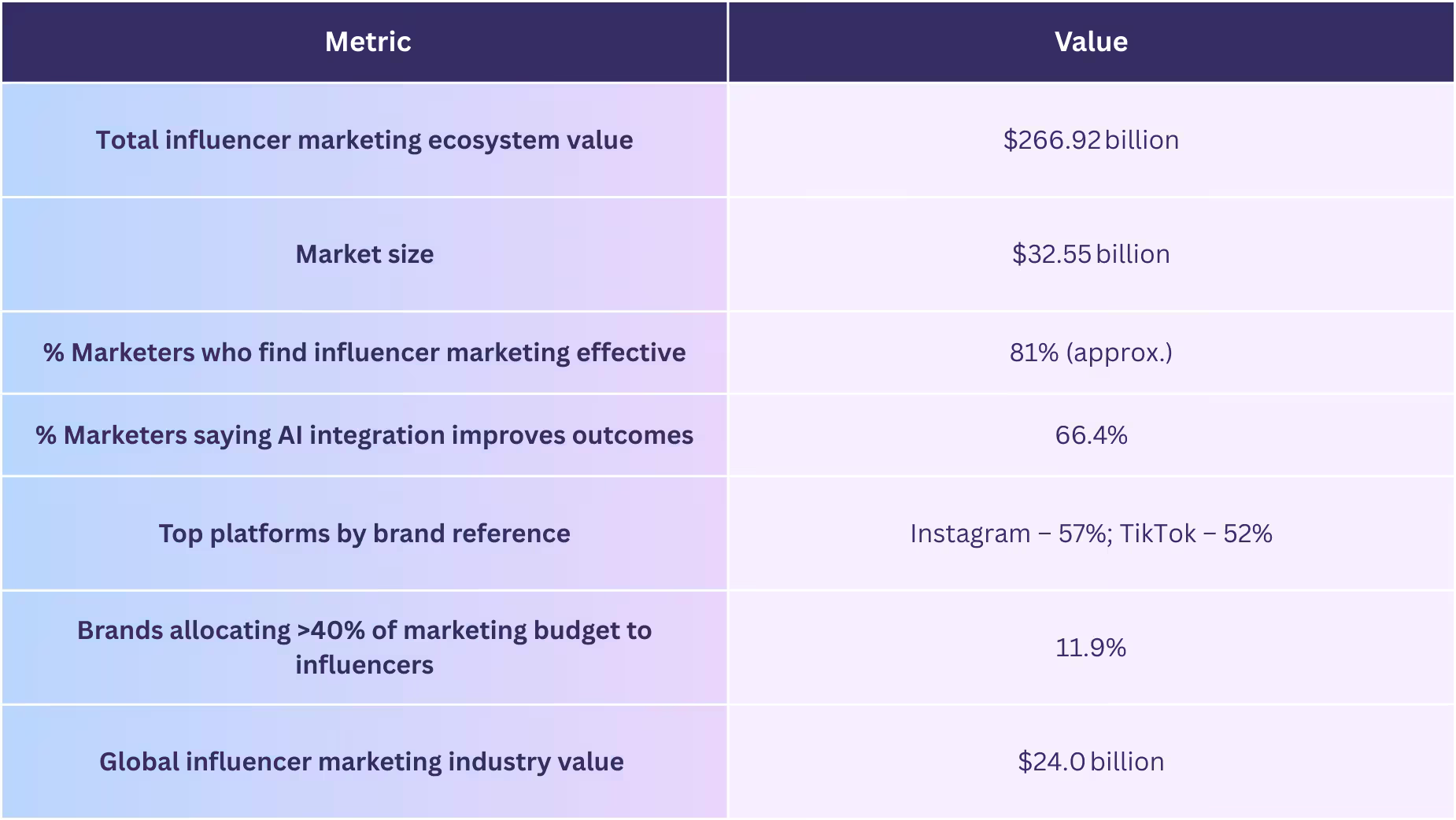
Global growth underscores a crowded marketplace. Cutting through noise requires partnering with creators who align with your brand and deliver genuine value.
The UK Influencer Market
The UK is Europe’s most mature influencer market. IMARC Group estimates the UK market at $2.36 billion in 2024, projecting growth to $24.15 billion by 2033, a 29.5% CAGR (imarcgroup.com). Statista data cited by Kolsquare forecasts UK ad spend on influencer marketing to reach £930 million in 2024 and £1.3 billion by 2029 (kolsquare.com). This makes the UK market more than twice the size of France’s or Germany’s (kolsquare.com).
The creator pool is deep. Kolsquare estimates 98,000 UK Instagram accounts with more than 5k followers and 633,000 with more than 1 k followers (kolsquare.com) – far more than France or Germany. This fragmentation enables brands to adopt a tiered strategy across nano, micro, mid‑tier and macro influencers.
Spending has surged: between 2019 and 2023, UK influencer marketing spend increased by more than £540 million (iclg.com). The ASA notes that ad spend more than tripled during that period (uk.themedialeader.com).
For wider context, UK advertisers spent £11.5 billion on social media ads in 2025, up 21%, with video making up 59% of it (iabuk.com, IAB UK Digital Adspend 2025). The IAB doesn’t break out influencer spend, so the influencer-only UK figures above are still estimates from market-research firms.
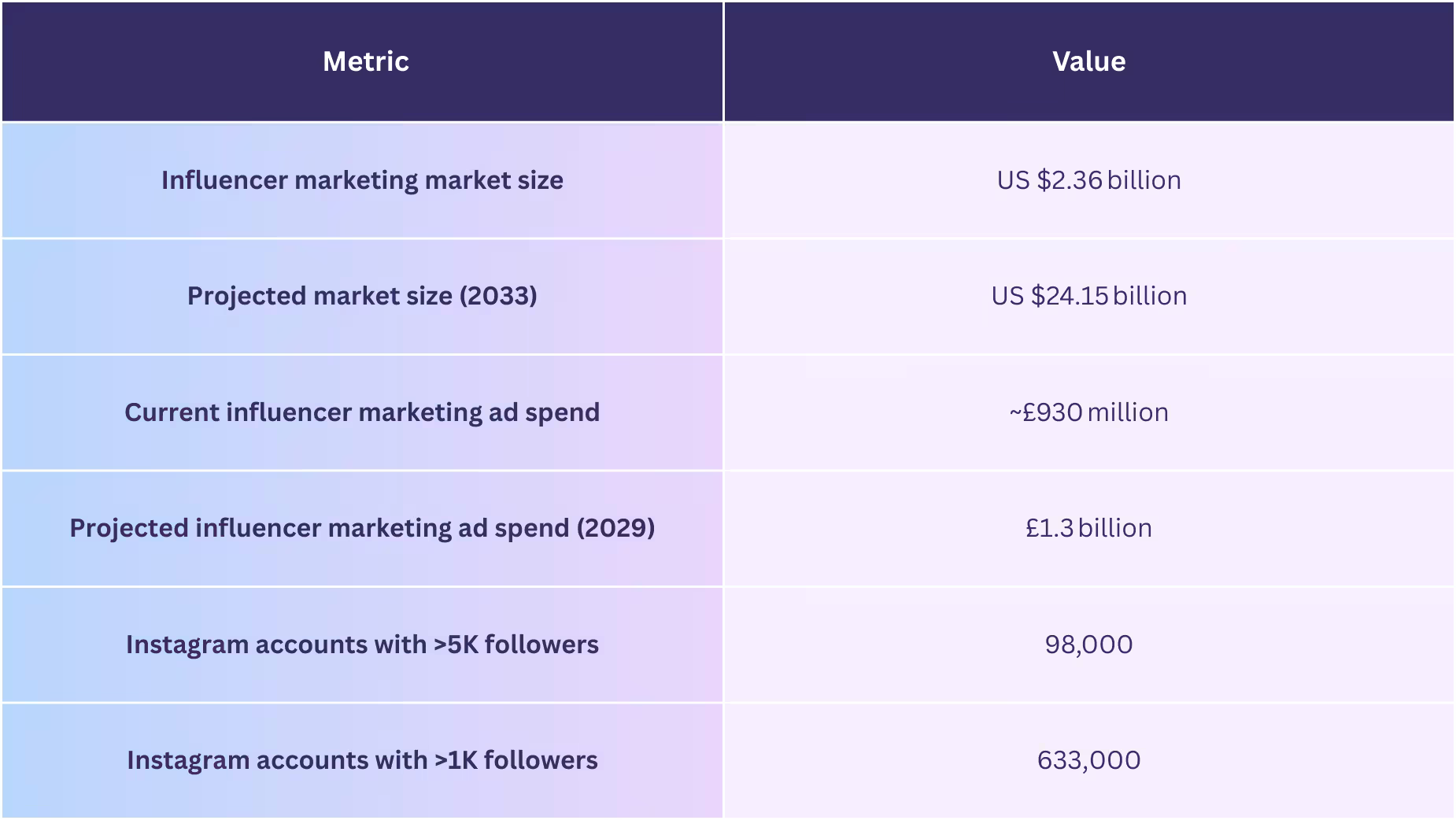
These numbers show a high‑spending, fragmented market. Success depends on careful influencer selection and alignment with audience and brand values.
Effectiveness & consumer behaviour
Marketers continue to invest in influencer partnerships because they work. Surveys compiled by Adam Connell reveal that 83 % of brands consider influencer marketing effective and 82 % say it generates the best-quality leads (adamconnell.me). On average, brands allocate 25 % of their marketing budgets to influencers (adamconnell.me). Campaign objectives skew towards user‑generated content (45 %), sales (29 %) and awareness (26 %) (adamconnell.me).
Consumer trust is equally high. An IZEA survey of UK social media users found that 54 % trust influencer posts more than celebrity ads and 55 % prefer influencer-created content (izea.com). A majority (51 %) have purchased products promoted by influencers (izea.com), rising to 79 % among 18‑29‑year‑olds (izea.com). Nearly 70 % of creators under 44 use AI tools, whereas only 20 % of those over 60 do (izea.com), and 48 % of younger adults follow AI or virtual influencers (izea.com).
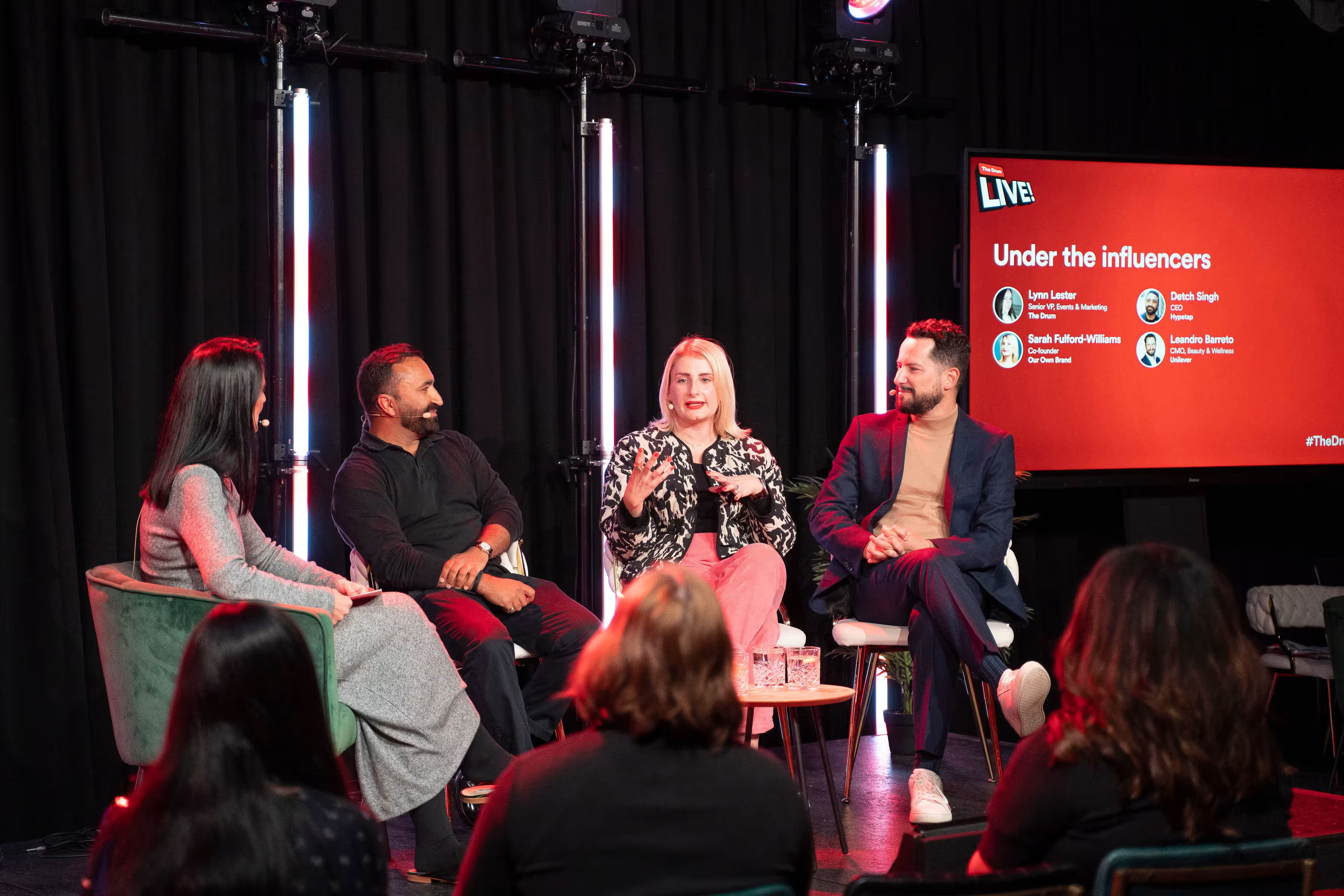
🔥 At The Drum Live 2025, OOB’s co-founder Sarah Fulford-Williams joined Hypetap’s Detch Singh and Unilever’s Leandro Barreto to spotlight a game-changing shift in influencer marketing: the magic happens when brands let go of the script.
Barreto shared how Vaseline’s Verified campaign handed creative control to 450 creators, leading to millions of organic views and cultural credibility that rigid brand content just can’t replicate. Our co-founder said: “People love content that feels real, independent and raw.” To capture that feeling brands must loosen their grip, which means “letting people interpret your brand.”
The takeaway? Influencers aren’t just endorsers, they’re co-authors of brand identity. Give them the freedom, and they’ll show you what your brand really means to people.
OOB’s Creator Collective
Through our Creator Collective we’re building a global network of diverse and trusted creators, so that we’re ready with the perfect voice for your brand.
Conclusion
Influencer marketing in 2026 is a powerful, sophisticated channel. The global and UK markets continue to expand, audiences trust creators and new technologies like AI and social commerce unlock fresh opportunities. Yet challenges persist: compliance remains a work in progress and brands must prioritise authenticity and data‑driven strategies to stand out. By partnering with the right creators, valuing transparency and investing for the long term, businesses can turn influencer marketing from a tactical play into a core growth engine.
Need help designing an influencer campaign that cuts through and complies? Explore our Social Media & Influencer Campaign Services to see how Our Own Brand can drive results for your next launch.
Want a team to make this happen for your brand? OOB is a full-service social media agency in London, with strategy, content, paid and community under one roof.
This one's on us.
OOB is a social media agency. If this sparked something, let's talk.