-CCy0IUJ0bfvN5VgUHVy1KammUOMDh8.webp&w=3840&q=75)
In 2025, the most loved brands are the ones with personality. Product is important, but personality is a key brand identifier. It helps consumers relate to your brand, creating that “we’re just like you” feeling, and giving them an identity to buy into that feels like an extension of themselves.
At Our Own Brand (OOB), the UK’s top marketing agency, we know identity is the foundation that brand meaning is built on, and foundations need to be strong.
One powerful tool we use to achieve this is our Brand Archetypes Framework, derived from Carl Jung’s theory of personality. This guide is an intro to the 12 Brand Archetypes, and their application as a framework for developing memorable, resonant brand identities.
Pop the kettle on and settle in! 📖☕️
What Are Brand Archetypes?
Brand archetypes are twelve universal personas that each speak to a core aspect of the human psyche. The twelve archetypes are derived from Carl Jung’s theory that these archetypes tap into universal human patterns, innate desires and behavioural drivers.
Who Is Carl Jung?
Carl Gustav Jung was one of psychology’s most influential pioneers. During the twentieth century, he developed a unique way to characterise the human psyche, introducing the concept of archetypes as part of his theory of the collective unconscious.
In branding, these archetypes help craft identities that resonate with audiences by tapping into universal human patterns.
How Can Brand Archetypes Develop Brand Identity?
Brand archetypes simplify the brand development process with clear, relatable personas that can help to guide marketing strategies, storytelling, and brand identity.
By using archetypes, brands can:
- ✅Create a consistent and compelling brand message
- ✅Shape brand personality and better define target audience
- ✅More closely align and connect with the needs, wants & values of their audience
- ✅Differentiate in a crowded market
- ✅Build trust and loyalty among consumers by being authentic and relatable (i.e., “we get you because we are you”)
The OOB Brand Archetype Wheel (2025)
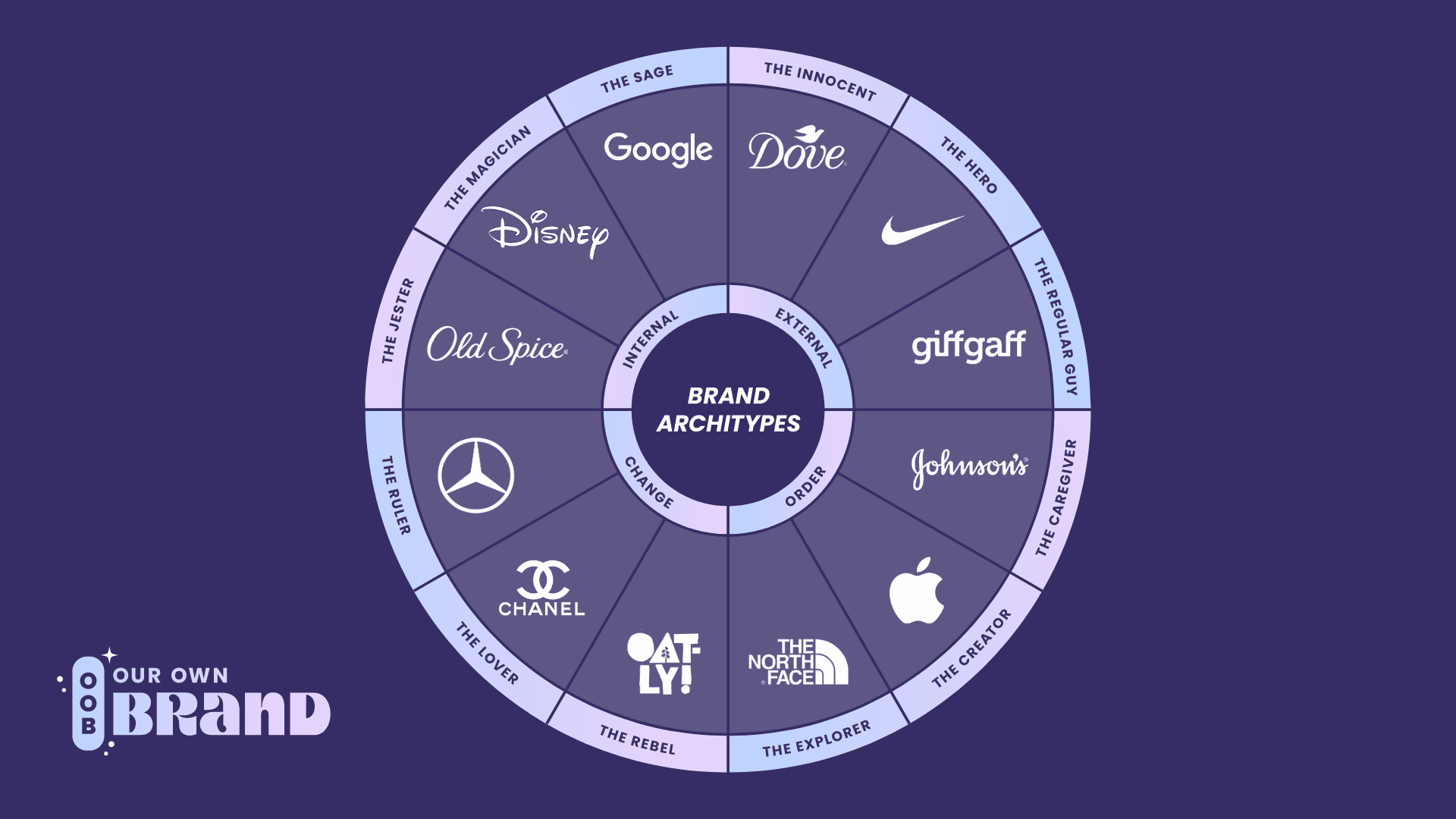
The brand archetype wheel is a visual tool that helps brands identify their primary and secondary archetypes. We’ve created our own version here at OOB to help guide our brand and design thinking.
It provides a clear framework for understanding how archetypes are used to draw out the essence of a brand’s personality.
Utilising the brand archetype wheel ensures consistency in messaging and visual identity, aligning all elements of the brand narrative 💫

The 12 Brand Personality Archetypes
1. The Innocent 🕊️
The Innocent archetype embodies purity, safety, and optimism. Brands that align with this archetype are seen as trustworthy and endearing.
- Traits: Optimistic, honest, cheerful
- Fears: Doing something wrong, being punished
- Goal: To be happy and bring happiness to others
- Strategy: Do things right, maintain integrity
- Example Brand: Dove
- Brand Message: “Let’s Change Beauty.”
2. The Explorer 🗺️
The Explorer archetype values freedom, adventure, and discovery. These brands inspire people to step outside their comfort zones and explore new possibilities.
- Traits: Ambitious, independent, adventurous
- Fears: Conformity, entrapment
- Goal: To experience a fulfilling life
- Strategy: Seek new experiences, escape boredom
- Example Brand: Patagonia
- Brand Message: “We’re in business to save our home planet.”
3. The Sage 🔭
The Sage archetype is driven by the pursuit of knowledge and truth. Brands that embody the Sage are viewed as wise owls, experts and reliable sources.
- Traits: Wise, reflective, analytical
- Fears: Ignorance, being misled
- Goal: To understand the world
- Strategy: Research, analysis, gather information
- Example Brand: Google
- Brand Message: “Seek and share wisdom.”
4. The Hero 🦸🏻♀️
The Hero archetype strives for mastery and improvement. Brands associated with the Hero inspire others to achieve greatness through courage and determination.
- Traits: Courageous, determined, honourable
- Fears: Weakness, failure
- Goal: To prove worth through courageous acts
- Strategy: Become as strong and competent as possible

5. The Rebel 😎
The Rebel archetype desires revolution and liberation. Brands that align with this archetype are seen as disruptors and rebels.
- Traits: Rebellious, iconoclastic, wild
- Fears: Powerlessness, being controlled
- Goal: To break the rules and fight authority
- Strategy: Disrupt, destroy what isn’t working
- Example Brand: Harley-Davidson
- Brand Message: “Freedom for the soul.”
6. The Magician 🔮
The Magician archetype seeks transformation and change. Brands embodying this archetype promise to transform customers’ lives in meaningful ways.
- Traits: Visionary, charismatic, imaginative
- Fears: Unintended negative consequences
- Goal: To make dreams come true
- Strategy: Develop a vision and live by it
- Example Brand: Apple
- Brand Message: “Think different.”
7. The Regular Guy/Girl 🙋🏻♀️
The Regular Guy/Girl archetype represents belonging and connection. These brands are seen as approachable and relatable, creating a sense of community.
- Traits: Down-to-earth, empathetic, relatable
- Fears: Standing out, being rejected
- Goal: To belong, fit in
- Strategy: Develop ordinary, solid virtues
- Example Brand: IKEA
- Brand Message: “Affordable design for everyday living.”
8. The Lover ❤️🔥
The Lover archetype values intimacy and passion. Brands that embody the Lover archetype appeal to emotions and the senses, fostering deep connections.
- Traits: Passionate, sensual, committed
- Fears: Being alone, unloved
- Goal: To build relationships and inspire love
- Strategy: Become attractive, build intimacy
- Example Brand: Chanel
- Brand Message: “Indulge in passion.”

9. The Jester 🃏
The Jester archetype seeks fun and enjoyment. Brands that align with this archetype bring joy and laughter, encouraging people to live life to the fullest.
- Traits: Playful, humorous, light-hearted
- Fears: Boredom, being boring
- Goal: To live in the moment with full enjoyment
- Strategy: Play, make jokes, be funny
- Example Brand: M&M’s
- Brand Message: “Championing the power of fun.”
10. The Caregiver 💆🏽♀️
The Caregiver archetype focuses on service and care. Brands embodying this archetype are seen as nurturing and supportive, putting others’ needs first.
- Traits: Compassionate, nurturing, selfless
- Fears: Selfishness, ingratitude
- Goal: To protect and care for others
- Strategy: Help others, make sacrifices
- Example Brand: Johnson & Johnson
- Brand Message: “We care for you.”
11. The Creator 💡
The Creator archetype values innovation and authenticity. Brands that align with the Creator inspire creativity and originality in their audience.
- Traits: Creative, imaginative, expressive
- Fears: Mediocrity, poor execution
- Goal: To create something of enduring value
- Strategy: Develop artistic control and skill
- Example Brand: LEGO
- Brand Message: “Unleash creativity.”
12. The Ruler 👑
The Ruler archetype desires control and order. Brands embodying this archetype project authority and leadership, setting standards in their industry.
- Traits: Authoritative, responsible, organised
- Fears: Chaos, being overthrown
- Goal: To create a prosperous, successful family or community
- Strategy: Exert leadership, seek control
- Example Brand: Mercedes-Benz
- Brand Message: “Lead with authority.”
How to Determine Your Brand Personality from Your Archetype
- ✅ Assess Your Core Values: Reflect on your brand’s mission, vision, and values. What drives your business?
- ✅ Understand Your Audience: Consider who your target audience is and what they value. What archetype would resonate with them?
- ✅ Analyse Your Competitors: Look at the archetypes your competitors embody. How can you differentiate your brand?
- ✅ Define Your Brand Voice and Visual Identity: Ensure that your brand’s voice and visual elements align with your chosen archetype.
- ✅ Consistency is Key: Maintain consistency across all touchpoints to reinforce your brand personality.
How to Use Brand Archetypes in Branding
Brand archetypes are a powerful tool for building a cohesive, relatable, and emotionally resonant brand. Here’s how to apply them across your branding process, from core strategy to visual identity, storytelling, and consumer engagement.
🎯 1. Brand Strategy: Aligning Archetypes with Business Goals
Using brand archetypes in your brand strategy helps anchor your messaging and positioning. Start with these essential steps:
- Define Your Core Values: Reflect on your brand’s mission, vision, and values. What drives your business?
- Identify Your Brand Archetype(s): Choose a primary and secondary archetype that reflect your brand’s personality and align with your audience’s values and aspirations.
- Develop Your Narrative: Use your chosen archetype to shape your brand story. Ensure the tone, messaging, and ethos are consistent across all brand messaging.
🎨 2. Brand Identity: Visual and Verbal Expression of Archetypes
Your brand identity, from your logo to your language, should reflect the traits of your chosen archetype(s).
Visual Branding:
- Use archetypal imagery, that reflect your brand’s core personality.
🎯 So, which archetype are you?
Whether you’re a Hero charging forward or a Jester cracking jokes along the way, tapping into brand archetypes gives your brand depth, clarity, and a whole lot of personality.
👉 Ready to rebrand? Let’s chat
Want a team to make this happen for your brand? OOB is a full-service social media agency in London, with strategy, content, paid and community under one roof.
This one's on us.
OOB is a social media agency. If this sparked something, let's talk.