Introduction
It wasn’t long ago that AI images were good for a laugh. Weird hands, extra limbs. Cartoon Will Smith eating spaghetti. It was fun, chaotic, and obviously fake. But those days are over. Tools like Nano Banana 2 can now generate hyper-realistic visuals in seconds, and the impact is hitting everything from news cycles to social feeds. Plus, Will Smith now looks like he’s actually tucking into a bolognese. Trust in what we see is rapidly eroding and we’re all left wondering, is this AI? (Fotoware).
Creative Brief confirms this, finding that 90% of global consumers want to know if an image was made using AI. That stat alone tells you everything: people are desperate for clarity. We saw this problem coming, but the solution arriving now might be one of the biggest shifts for marketing, content, and digital culture. And honestly, it couldn’t land at a better time.
But what are content credentials?
Content Credentials are a universal system for proving exactly where a piece of content came from and whether anything has been done to it along the way.
The Coalition for Content Provenance and Authenticity (C2PA), a group that includes Adobe, Canva, Google, Microsoft, OpenAI, Meta, TikTok, AP, the BBC, Sony, Amazon and many more, has built a standard that lets anyone inspect the full history of an asset. Photos, videos, audio files, you name it. You can see whether it’s authentic, AI-generated, or manipulated.
Think of it like a nutrition label, but for media. Instead of calories and ingredients, you get:
- Who created the content
- Which device or software captured or edited it
- What edits were made
- Whether AI was used
- Whether anything suspicious happened along the way
All this info is sealed inside the file using cryptographic signatures, meaning it can’t be quietly changed or erased. And crucially, it stays attached to the asset wherever it goes, even after posting or downloading. It’s as neat as blockchain tech.
How does it work?
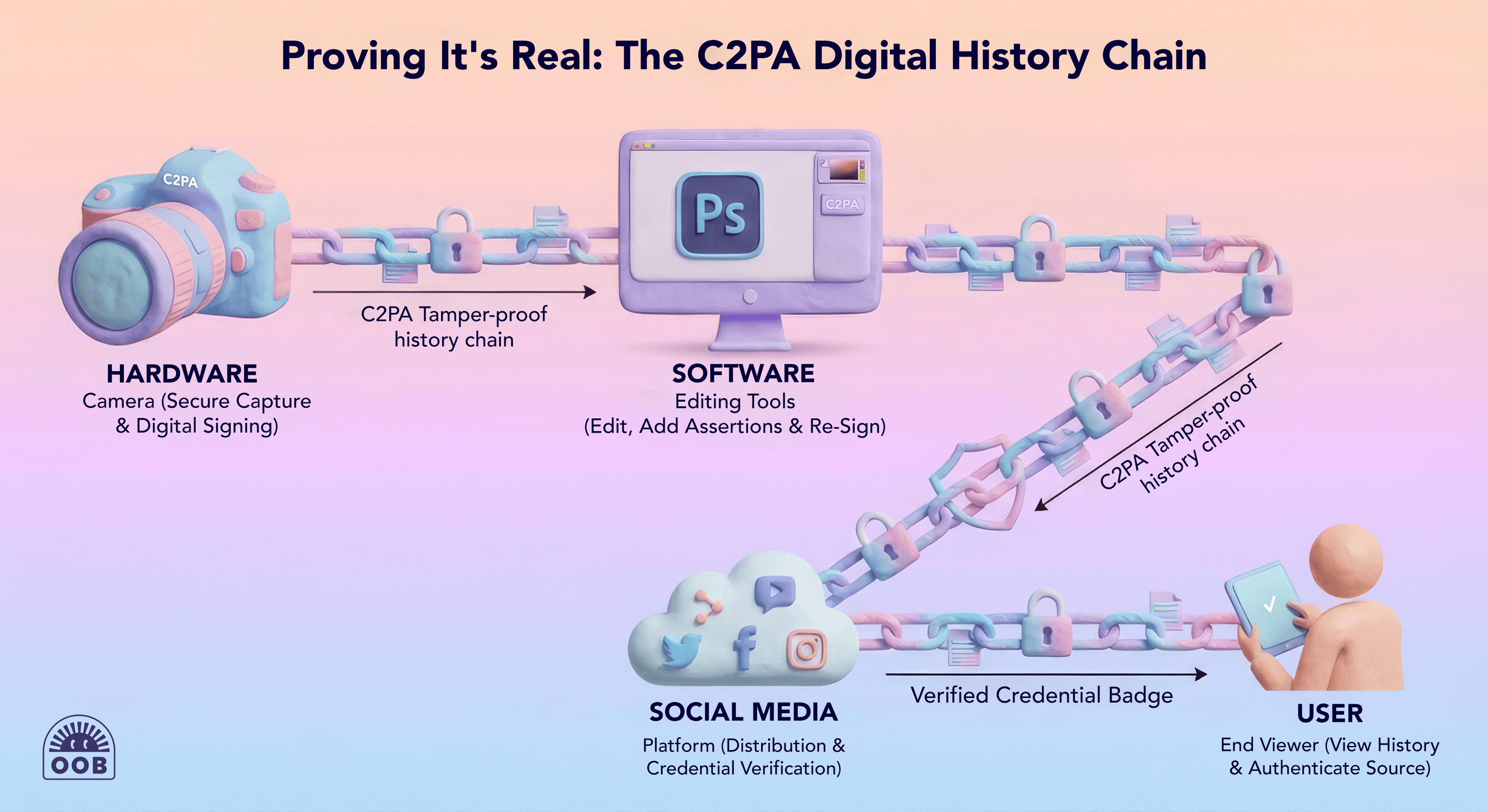
- Content is captured: A camera or app records a photo or video. Devices that support C2PA – like Sony’s new PXW-Z300 or Google’s Pixel 10 – stamp the file with a signed certificate at the moment of capture
- Content is edited: Tools like Adobe Firefly, Photoshop, Premiere and enterprise editing software log each edit and maintain the provenance chain
- Content is published: Newsrooms, brands and platforms embed a final signature that confirms the authenticity of the published file
- Anyone can verify it: Viewers simply click the “Content Credentials” icon to see who captured it, whether it was edited, and whether AI was used. If metadata is missing or has been stripped out, the system immediately flags it
In short, it’s a signpost for what’s human-made in a world of increasingly convincing AI generated content.
Our policy at OOB
We’re curious by nature and we’re always hands on with emerging tech, and AI is no exception. Right now we’re actively testing what AI can do to elevate our human-created work (not to replace it) and the results are incredible. TikTok native music. Elevated video moments. Visuals that feel intricately crafted.
But we’re equally aware of the responsibility. Transparency matters. Provenance matters. And as C2PA becomes part of the industry conversation, brands are going to have to decide where they stand.
Here are the big questions we’re exploring:
- Are our clients comfortable with using AI?
- Which tools genuinely add value to our creative output?
- How will provenance and transparency reshape marketing and media?
- Could authenticated content rank higher in social algorithms?
- Will C2PA metadata become part of brand governance, compliance and approval workflows?
- Will creators build transparency into their personal branding?
- Could content verification eventually be a legal requirement?
- Will platforms start introducing badges, filters or labels for Credentialled Content?
- And the cultural one: will people actually care enough to check? Or will they only care when something looks suspicious? The Drum explored this tension recently.
C2PA is more than provenance tech. It’s the next standard for digital trust. The brands who build with clarity, transparency and proof will be the ones who stand out in the next era of social.
Want a team to make this happen for your brand? OOB is a full-service social media agency in London, with strategy, content, paid and community under one roof.
This one's on us.
OOB is a social media agency. If this sparked something, let's talk.