The Psychology of Change
Last month, OOB headed to The Drum Live’s 2025 exclusive 48-hour content sprint, to hear from and chat with marketing leaders about their views on industry hot topics. Across back-to-back live debates, there was one word that almost always got a mention: AI. Usually followed by “change” or “uncertainty” or “agile”. With all of the hype around AI, talk of it retiring the traditional advertising model but not quite beating a human touch, and the perceived pressure to stay “agile”, it suddenly feels like the future is here. But is it really here, or is it just an illusion?
In a recent interview with Contagious, behavioural scientist Richard Sotton said:
💬 “If you think about evolutionary psychology as the driver of human nature, you realise it’s ludicrous to think anything should change in five to 10 years, because that’s just a blink of an eye in the hundreds of thousands of years we’ve been around.”
AI is everywhere. The question is: Is this buzz creating the feeling of things changing quicker than they really are? Or are businesses really already behind?
Why does change feel faster than it is? ⏩
Let’s unpack the psychological phenomena behind why change might feel faster than it is.
The Hype Cycle (Gartner) 🙌
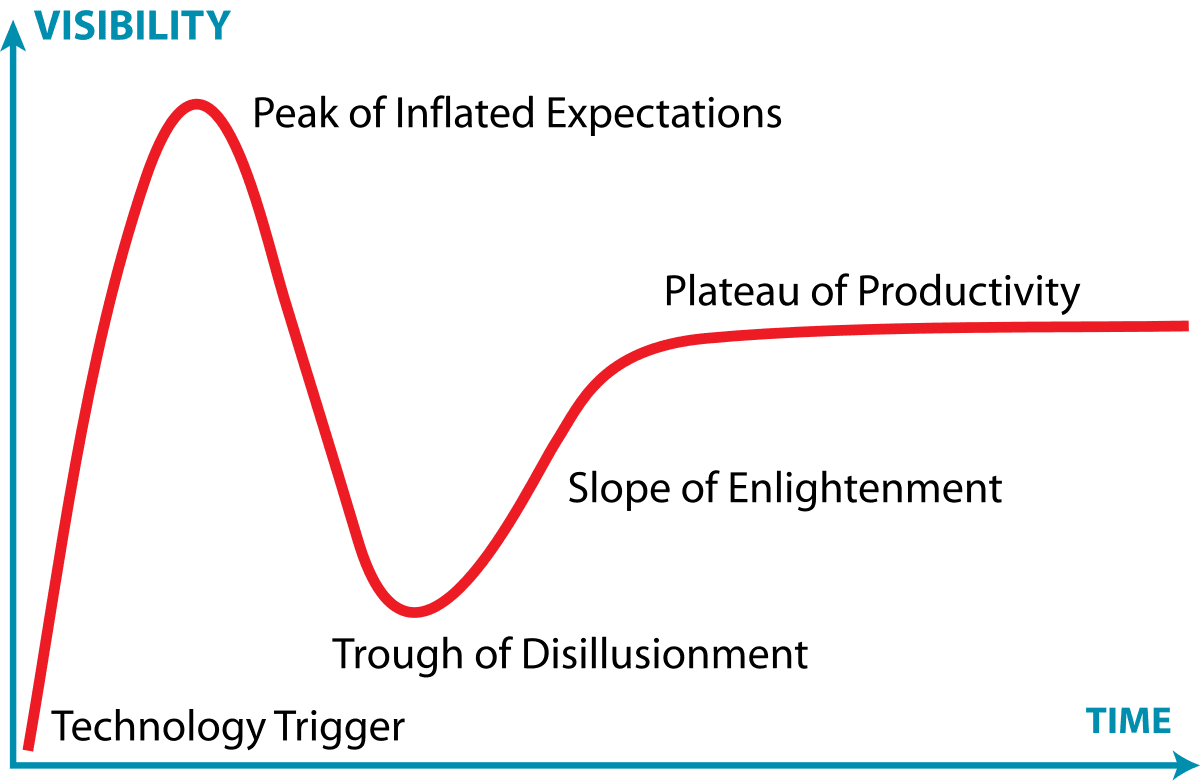
Any new technology tends to follow a predictable curve: inflated expectations → disillusionment → gradual adoption. At the peak, people feel as though the future has already arrived, even if widespread change and mainstream adoption are still years away.
The Availability Heuristic 📱
We tend to perceive things as more imminent if we encounter them often in conversation or media. Have you seen, read, or heard a lot about AI recently? Maybe in conversation, in the news, while trawling through LinkedIn…? If AI is everywhere in your feed, your brain thinks it’s everywhere in reality.
Presentism & Recency Bias 🏆
Humans tend to assume that the present moment is unique because it’s the one we’re living through. We overestimate how much is changing now compared to much slower, invisible processes in the background.
So psychologically, the illusion of “everything changing overnight” happens because:
- Our attention is hijacked by novelty and media amplification.
- Evolution primed us to notice immediate change (survival value), but we’re poor at grasping long-term, structural timelines.
- Narratives of “the future is here” are sticky and persuasive, they make us feel like participants in history, not just observers.
Is radical change likely to happen now? 🧑🏫
If rapid change can be an illusion, how can we tell when things are actually changing? Looking back at history is a good place to start. If we zoom out over recent centuries, true “step-changes” (shifts that restructured daily life across much of the world) are relatively rare.
Some examples:
- Industrial Revolution (late 1700s–1800s): Mechanisation, steam power, urbanisation.
- Electrification (late 1800s–early 1900s): Light bulbs, factories, appliances.
- Automobiles & Mass Production (early 1900s): Changed cities, labour, transport.
- Television & Mass Media (mid-1900s): Global culture and advertising.
- The Internet (1990s): Communications, commerce, information access.
- Smartphones (2007 onward): The “always connected” era.
Each of these took decades to embed, even the internet took 10-15 years from mainstream adoption to rewiring culture and business. If you average it out, paradigm-shifting change tends to cluster about once every 20-30 years in modern history. In between, there are smaller but powerful advances (e.g., social media, streaming, cloud).
Could AI Be the Next “Step-Change”? Why This Time Feels Different ⚡️
Yes, it’s plausible. AI resembles the internet in the 1990s: early, messy, overhyped in some areas, but with deep infrastructure-level implications that may only reveal themselves over decades. Just as Millennials grew up with Google, Gen Z grew up with iPhones and a social media addiction (oops), so could Gen Alpha grow up with AI as the norm.
If we’ve always overestimated the speed of change, then what makes this time any different?
The answer could be this: AI isn’t a single invention, it’s an enabling layer that touches everything.
- Past revolutions were narrower: Cars transformed transport. Electricity transformed energy. The internet transformed communications. Each was sweeping, but they had a clear domain of impact.
- AI’s breadth: It’s not “one thing”, it can impact every industry simultaneously: marketing, medicine, art, transport, tech, entertainment. That multiplicity may compress adoption timelines because it doesn’t wait on one industry.
- The network effect: Because AI is layered on top of existing digital infrastructure (cloud, smartphones, global internet), it can scale faster than past revolutions. The car needed roads built, AI needs servers and APIs, which are already there.
That said, true change still requires integration and trust. The internet was technically capable in the 1980s, but only transformed culture once broadband, browsers, and social platforms aligned in the 2000s. AI may follow a similar curve: explosive possibilities now, but deep rewiring later.
What does this mean for brands? 👀
Unlike past revolutions tied to one product or industry, AI is an enabling layer that cuts across them all, meaning adoption could be faster, deeper, and harder to ignore. The safe play isn’t waiting it out. Brands that decide to use AI for content creation beyond initial ideas need to consider transparency and copyright, and plan for every kind of customer, from AI skeptics to Gen Alpha natives. But for most brands, it’s about experimenting early, learning how AI can complement creativity with quick initial iteration, and spotting the helpful from the hype.
For more, check out Our Own Brand 💫
(We're hands-on with this at OOB Labs, where we build free AI tools that read brands the way algorithms do.)
Want a team to make this happen for your brand? OOB is a full-service social media agency in London, with strategy, content, paid and community under one roof.
This one's on us.
OOB is a social media agency. If this sparked something, let's talk.